
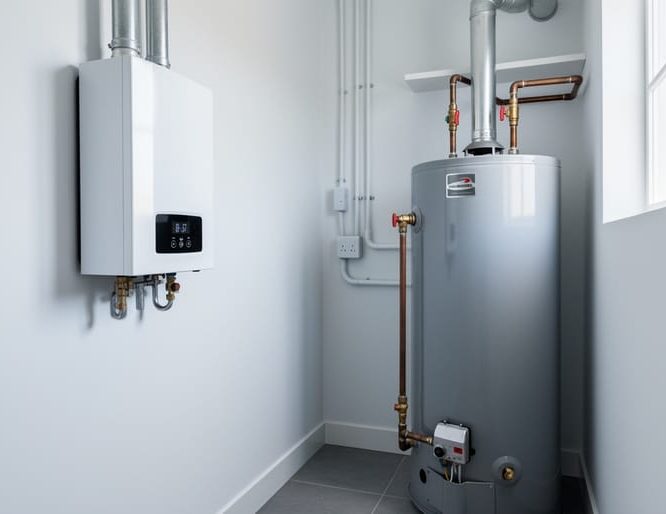
If your utility closet is smaller than a coat rack, the best space saving water heater is usually a tankless electric unit, with a compact heat pump model as the pick if you have a bit of floor room and want lower running costs. Tankless units mount on the wall and take up roughly the footprint of a small suitcase. A conventional tank, by comparison, can swallow a whole corner of your garage or hallway nook.
In the interest of transparency, we earn a commission on some purchases made through links on this site. As an Amazon Associate I earn from qualifying purchases.
That trade-off is the heart of this guide. Smaller doesn’t automatically mean better. A tankless heater frees up floor space, but it needs the right electrical setup and enough power to keep up with your showers. Heat pump models, like the Senville Hybrid Heat Pump Electric Water Heater and the Rinnai REHP65 Electric Heat Pump Water Heater 65 Gallon Energy Star take more room but can be two to three times more energy-efficient than conventional electric water heaters, according to Consumer Reports. Some states even offer tax incentives for making the switch.
We pay close attention to how every square foot gets used, whether it’s a backyard pond, a small fountain, or a utility corner. Tight spaces reward careful planning, and a water heater is no exception. Below, we compare the main types, walk through what to measure before you buy, and cover eight specific models, so you can pick one that fits your space and your household without any surprises on install day.
Why Small Spaces and Water Features Share the Same Smart Thinking
Anyone who has planned a pondless waterfall knows the trick: you get the sound, the sparkle and the calm without digging a giant pond. A hidden basin, a compact pump, and a few well-placed stones can turn a corner of the yard into the best seat in the house. The beauty comes from the design, not the footprint.
Water heaters deserve the same thinking. That old 40-gallon tank in the corner of your garage or utility closet isn’t doing much for you except hogging floor space. Swap it for something slimmer and suddenly there’s room for a shelf of pump parts, a bin of winter pond supplies, or just a spot to walk without turning sideways.
I’ve talked with plenty of homeowners who started out wanting to build a backyard water feature and ended up rethinking their whole utility area to make space for the gear. Others set out to transform your pond and realized the garage needed a little reorganizing first.
Whichever camp you’re in, the idea is the same: shrink what you don’t love so you have more room for what you do.
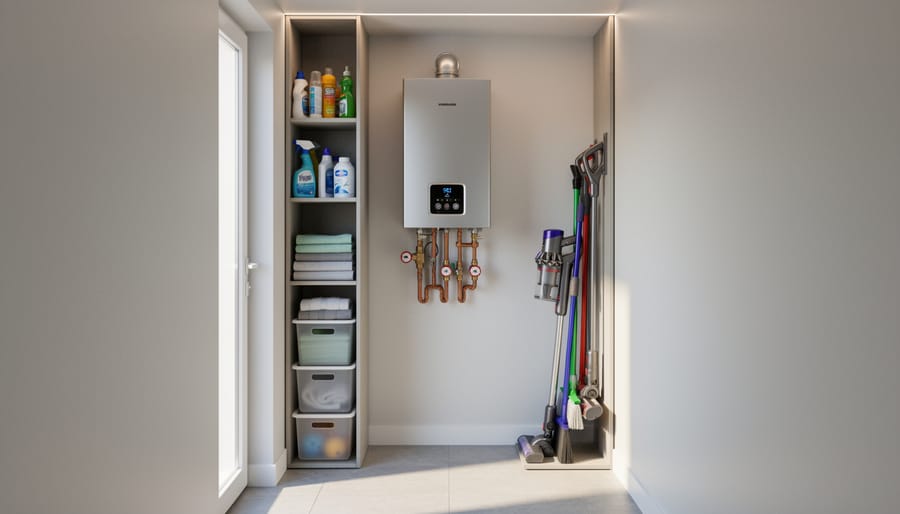
Key Buying Factors for a Space-Saving Water Heater
How Much Hot Water Do You Really Need?
Think of flow rate, measured in gallons per minute (GPM), as how much hot water a unit can deliver at once. The key question is how many things will be asking for hot water at the same moment.
A shower typically uses somewhere around 2 GPM, a kitchen sink a bit less, and a washing machine pulls its own share on top of that. Run two at once and you’re adding those numbers together. For a rough sense of scale, the 2.1 GPM 240-volt tankless category handles about one modest demand at a time, while the Stiebel Eltron Tempra 24 Plus, rated at 4.68 GPM, can cover more at once.
Here’s a simple way to match capacity to your space:
– Single bathroom or guest bath: a lower-flow unit usually does the job if only one fixture runs at a time.
– Garage workshop or utility sink: a small point-of-use heater is often plenty, since you’re rarely running more than one tap.
– Small home with showers and laundry overlapping: aim higher, so the shower doesn’t turn cold when the washer kicks on.
Count your busiest morning, then size to that.
Checking Your Power Before You Fall in Love With a Model
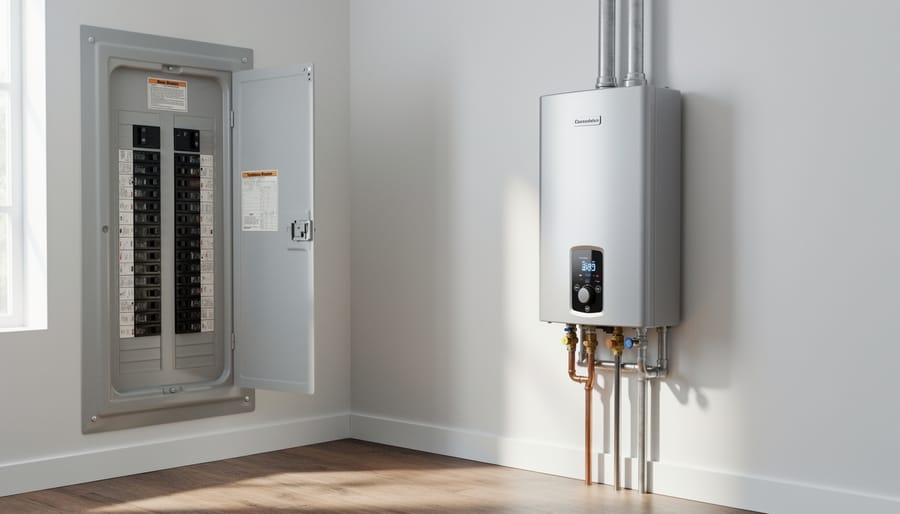
Before you fall for a model, check what your home can actually power. Electricity is the catch with compact tankless units, because heating water on demand pulls a lot of power all at once.
That’s why bigger units, like the 240-volt, 2.1 GPM category or a high-capacity model such as the Stiebel Eltron Tempra 24 Plus (rated at 24 kW), need 240V service and plenty of spare capacity in your electrical panel. Think of it like a garden hose: a wider hose moves more water, and a heavier circuit delivers more power. Small under-sink and faucet units use far less, so many of them run on ordinary 110/120V and can plug into a standard outlet.
Some homes, especially older ones, simply don’t have room in the panel for a whole-home electric tankless unit. It may need a dedicated circuit, heavier wiring, or a panel upgrade.
Before you buy, have a licensed electrician look at your panel and wiring. It’s a quick check that can save you from a unit you can’t install.
Space-Saving Water Heater Types Compared
Three compact approaches cover most tight-space situations, and each one trades something different for the room it saves. Here’s how they stack up in plain terms.
| Type | Space needed | Best use | Main trade-off |
|---|---|---|---|
| Whole-home electric tankless | A wall-mounted box, no floor space | Small homes, apartments, additions | Needs strong 240V electrical capacity |
| Point-of-use and under-sink | Fits under a sink or on a wall | One sink, garage, workshop, outdoor kitchen | Can’t handle a shower or several fixtures |
| Hybrid heat pump tank | A floor footprint plus some clearance | Families who want lower energy use | Saves energy but still takes up floor room |
Whole-home electric tankless units are the biggest space winners. They hang on a wall and heat water only when you open a tap, so there’s no tank to house. The catch is power. A unit like the Stiebel Eltron Tempra 24 Plus is listed at 24 kW and 4.68 GPM, and numbers like that mean serious electrical demand. Have a licensed electrician confirm your panel can handle it before you shop.
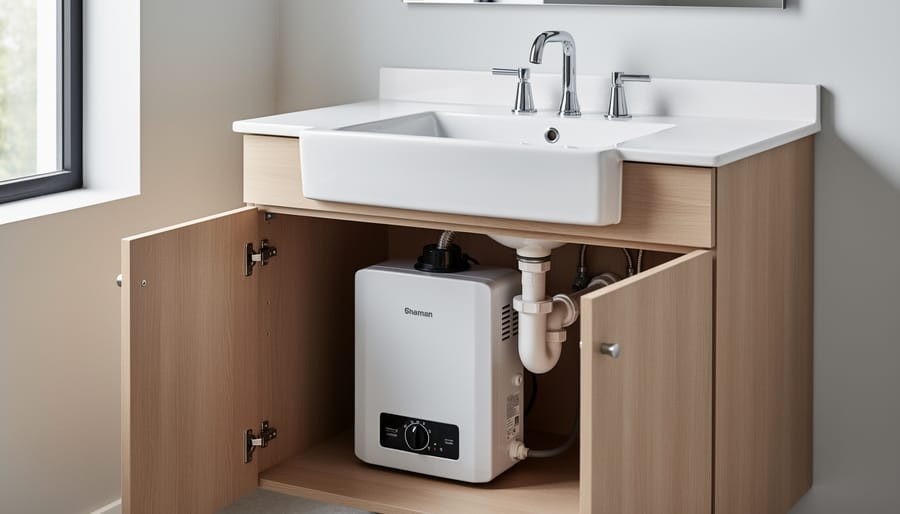
Point-of-use and under-sink models are the smallest of all. They sit right where you need hot water, which means no waiting for it to travel through long pipes. Many run on regular 120V power, so they’re easy to tuck into a garage, a guest bath, or an outdoor kitchen sink. They’re built for a faucet, not a whole household. If you prefer a small tank, the Rheem Performance 20 Gallon 2000-Watt point-of-use model, which carries a 6-year warranty, shows what a compact tank option looks like.
Hybrid heat pump tank models work a little differently. Instead of making heat from scratch, they pull warmth from the surrounding air, which is why they sip power. Consumer Reports says heat-pump water heaters can be two to three times more energy-efficient than conventional electric water heaters, and it notes they can use about 70% less energy than standard electric tanks. Some states also offer tax incentives for making the switch, so check your local programs. The trade-off is that you still need a tank’s worth of floor space, plus a little breathing room around it for airflow.
Think of it like choosing equipment for a small yard. The goal isn’t the smallest gadget, it’s the one where your water feature fits better in the space you actually have. The same logic applies indoors. Match the heater to your room, your power, and your daily habits, and the rest falls into place.
Our Picks: Compact Water Heaters Worth a Look
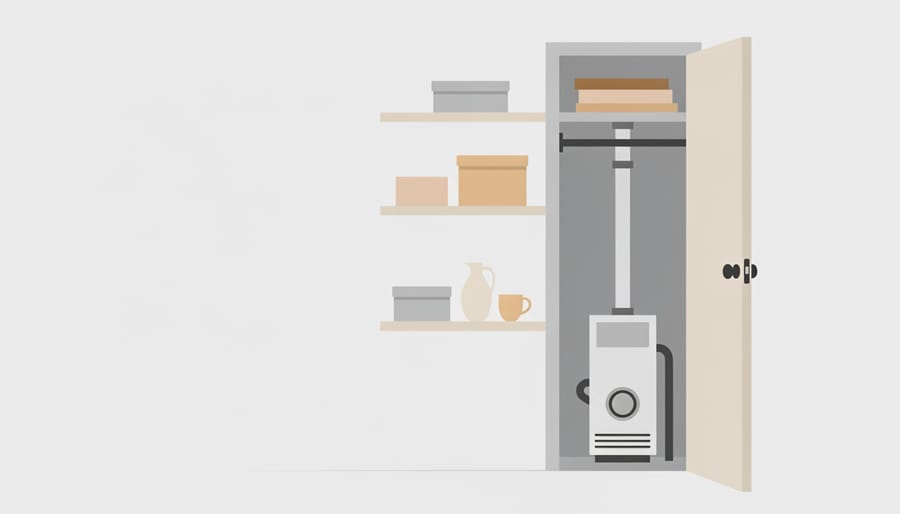
We grouped the picks below by how they save space: whole-home tankless units that mount on a wall, heat pump models that trade a little floor space for lower energy use, and small point-of-use heaters that tuck under a sink or into a corner. Ratings come from customer reviews on the retailer listings, so a handful of reviews tells you less than hundreds do, and we’ve pointed that out where it applies. We’ve left prices and deals out on purpose, since those change quickly. Start with the group that matches the room you have, then read the individual picks for the details.
Senville Hybrid Heat Pump Electric Water Heater: Efficiency With a Tank

The Senville Hybrid Heat Pump Electric Water Heater is the “efficiency with a tank” pick. It’s a 50-gallon, Energy Star unit, so it still holds a reservoir of hot water, but it heats that water differently than a standard electric tank.
Instead of relying only on a heating element, a heat pump pulls warmth from the surrounding air and moves it into the water. Think of it like a refrigerator working in reverse. Consumer Reports says heat-pump water heaters can be two to three times more energy-efficient than conventional electric water heaters, which is a big deal if your hot water use is steady and your bills sting.
The trade-off is space. This isn’t a wall-hugging tankless unit, so it suits families who want lower energy use and can spare a patch of floor in a garage, basement, or utility room. If your closet is truly tiny, look at the tankless picks instead.
Customers have given it a 5 out of 5 rating, but that comes from only 6 ratings. That’s encouraging, not conclusive, so read the specs and any newer reviews before you commit. It’s listed as in stock right now.
One more thing worth checking: Consumer Reports notes that some states offer tax incentives for switching to a heat-pump water heater. Look up your local programs, since they could soften the upgrade.
Rheem 11kW Multi Fixture Tankless Electric Water Heater: A Wall-Mounted Whole-Home Option

The Rheem 11kW Multi Fixture Tankless Electric Water Heater is a wall-mounted, 240V unit built to serve more than one fixture at a time. That makes it a natural fit for smaller homes, apartments, and additions where a bulky tank simply won’t fit. Mounted on a wall, it frees up the floor space a traditional tank would eat, which is a bit like choosing a pondless waterfall over a big pond: you still get the result, without the footprint.
Customers have rated it 4.1 out of 5 across 536 ratings, which is a solid base of feedback to read through before you decide. It’s listed as in stock, so you’re not waiting on a restock.
Before you get attached, think about the power side of things. A 240V electric tankless unit needs the right electrical service behind it, and an 11kW draw is not something to guess about. Have a licensed electrician look at your panel and wiring to confirm your home can handle it. Also keep your expectations realistic about hot water demand. Eleven kilowatts is a good match for a small household or a single bathroom and kitchen, but running several fixtures at once in a bigger home is where a higher-capacity model, or a different type altogether, may serve you better.
If your goal is reclaiming a closet or utility corner, this is a sensible place to start looking.
Stiebel Eltron Tempra 29 Plus Electric Tankless Water Heater: Power for Bigger Households

If you’ve got a bigger household and a utility closet that’s already tight, the Stiebel Eltron Tempra 29 Plus is the high-capacity pick in this roundup. It’s a 28.8kW, 240V electric tankless unit, which means it heats water on demand instead of keeping a big tank warm all day. That’s how it earns its place on a space-saving list: you get hot water for more people and more fixtures without giving up floor space to a tank.
For context, the Tempra family is built around a self-modulating design. The Tempra 24 Plus, a sibling model, is listed at 24 kW and 4.68 GPM, and it adjusts its heating output to match the flow rather than blasting at full power every time. We’re mentioning that only to show how the line works. Those numbers belong to the 24 Plus, not to this model, so check the 29 Plus specs directly before you size anything around it.
Customers have rated it 4.4 out of 5 from 455 ratings, and it’s in stock right now.
Here’s the honest trade-off. A unit this powerful needs substantial electrical capacity, and not every home’s panel can spare it. Before you fall for the compact footprint, have a licensed electrician look at your service and wiring. If your panel can handle it, this is a strong fit for a growing family. If not, one of the smaller picks may serve you better.
The Home Depot eGift Card: A Handy Option for Gifting a Water Heater Upgrade

This one isn’t a water heater at all, and we’d rather say so up front. The Home Depot eGift Card is simply a flexible way to help someone with a home upgrade, and it can be a thoughtful pick for a new homeowner who’s still figuring out what their place needs.
It also suits a friend who’s busy building a backyard water feature. They can spend it on whatever the project calls for, whether that’s a compact heater for the garage, a pump, or a bag of river rock.
It carries a 4.6 out of 5 rating from 815 customers, and it’s in stock right now. Think of it as the easy option when you’d like to help but don’t know the exact model or the electrical setup in their home.
110V Tankless Water Heater Electric: A Plug-In Choice for Sinks and Small Spots

This 3000W under-sink unit from Jflapil is a small point-of-use heater with a digital display, and it plugs into standard 110V power. That makes it one of the simplest ways to get hot water without giving up a closet or a chunk of floor space.
The idea is straightforward. Instead of waiting for hot water to travel from a big heater across the house, you put a compact unit right where the water gets used. Think of a kitchen sink, a utility sink, a garage workbench, or an outdoor kitchen where running a long hot line isn’t practical. Hot water shows up close to the tap, and the unit tucks under the sink or against a wall.
It’s rated 5 out of 5 from 25 customers, which is encouraging, though that’s a modest number of reviews, so read a few before you commit. At the time of the listing, only 10 were left in stock, so if it fits your spot, don’t wait too long.
Now the honest limits. A 3000W plug-in heater is built for sinks and light handwashing, not for a whole bathroom. Don’t count on it to run a comfortable shower, and it won’t keep up if several fixtures are going at once. Think of it as a helper for one spot, much like a small, well-placed feature that does one job nicely rather than trying to do everything.
Rinnai REHP65 Electric Heat Pump Water Heater 65 Gallon Energy Star: Big Capacity, Smart Efficiency

If you have a big household and a dedicated utility space, the Rinnai REHP65 is the one to look at. It’s a 65-gallon Energy Star heat pump water heater, which means it pulls heat from the surrounding air instead of relying only on electric elements. Consumer Reports says heat-pump water heaters can be two to three times more energy-efficient than conventional electric models. That’s real savings if you’re running hot water for several people every day.
Let’s be honest, though. This is the least compact pick in our roundup. A 65-gallon tank takes up real floor space, and heat pump units generally want some breathing room around them. It makes the most sense in a garage corner, basement, or utility room where the footprint isn’t a squeeze. Think of it like a big pond: lovely when you have the yard for it, but not the move for a tiny courtyard.
On availability, it’s currently in stock. The rating is a perfect 5 out of 5, but that comes from just 1 customer, so treat it as a first impression rather than a verdict. Before you buy, read as many reviews as you can find and go through the full specs. It also helps to check whether your state offers tax incentives for switching to a heat pump model, since Consumer Reports notes that some do.
Tankless Small Water Heater Electric 120V 29.2Amp: A Popular Compact Faucet Heater

If you only need hot water at one tap, this little unit is a smart way to skip the tank altogether. The Tankless Small Water Heater Electric 120V 29.2Amp from ThermoMate is a 3500W on-demand heater with a temperature display, built to sit at a kitchen or bathroom sink faucet. It’s ETL certified, and it’s in stock right now.
What stands out is the review base. It holds a 4.3 out of 5 rating from 1,366 customers, which is a far bigger sample than most compact heaters in this guide can claim. That counts for something when you’re weighing a small appliance you can’t easily test first.
Because it runs on 120V and is meant to serve a single faucet, it fits places where a tank never would. Think guest baths, workshops, laundry sinks, or a garage utility sink near your pond supplies. You get hot water right where you stand, with no long wait for the pipes to warm up.
Now the honest limits. A 3500W unit like this is not a whole-home solution. It’s designed for sink use, so don’t expect it to run a shower, let alone two fixtures at once. Think of it as a helper for one spot, not a replacement for your main water heater. If you need hot water across the house, look at the 240V tankless picks above instead.
ThermoMate 6kW Tankless Water Heater Electric: A Step Up for Small Washing Needs

The ThermoMate 6kW Tankless Water Heater Electric sits in a handy middle spot. It’s a step up from the plug-in faucet heaters, but it’s far smaller than a whole-home tankless unit. The listing calls it an ETL-listed model meant for sink and washing use, which tells you where it shines: a utility sink, a mudroom wash station, a small workshop, or a guest bath where you just want hot water without a tank taking over the corner.
Because it’s built for smaller jobs, think of it as a “close to the tap” heater. It won’t try to run several showers at once, and it isn’t meant to. If your needs are a sink or two and some basic washing, though, it keeps things compact and wall-friendly.
Customers have rated it 4.5 out of 5 from 68 customer ratings, which is a decent sample for a niche unit, and it’s currently in stock.
A 6kW electric heater draws real power, so wiring matters more here than with a little plug-in model. Have a licensed electrician check your circuit capacity and handle the installation, and ask a plumber to confirm the plumbing side. It’s a small investment of time that protects your home and keeps the unit running safely.
Which One Fits Your Home? Our Recommendations by Situation
Here’s how I’d match the picks to real situations.
A whole home and a tight closet: The Rheem 11kW Multi Fixture is the natural fit. It mounts on the wall, so it frees up the floor, and it’s rated for several fixtures. If your household is bigger or you run more things at once, the Stiebel Eltron Tempra 29 Plus gives you more capacity, though it needs serious electrical capacity behind it.
A family with floor space to spare: Go with a heat pump. The Senville 50-gallon suits a typical family, while the Rinnai REHP65 makes sense if you have a dedicated utility area and heavier demand. Consumer Reports says these can be two to three times more energy-efficient than conventional electric models, and some states offer tax incentives, so it’s worth checking your local programs.
One sink in a garage or outdoor kitchen: A small unit like the 110V under-sink heater or the 120V faucet-style model keeps hot water right where you use it. Need a bit more muscle for washing? The ThermoMate 6kW is a good middle step.
A gift: The Home Depot eGift Card lets someone choose their own upgrade.
Picture this, as a general example: a homeowner swaps a bulky tank for a wall-mounted tankless unit and suddenly has a clear corner. That space becomes a shelf for pump gear, filters, and seasonal supplies. It might even be where you finally keep your pond fish care tips notes handy, or the contact info for pond maintenance services.
Mistakes to Avoid When Buying a Compact Water Heater
The most common mistake is buying a unit that’s too small for your household. A plug-in faucet heater is great at a single sink, but it won’t keep up with a shower or a washing machine running at the same time. Add up what you actually run together, then pick a unit that covers it.
Next up is overlooking your electrical setup. Many whole-home electric tankless models draw serious power, and your panel may not have room for them.
Heat pump models bring their own trap. They pull heat from the surrounding air, so the unit requires free air space around it to work well. Tuck one into a cramped closet with no airflow and you’ll lose the efficiency you were paying for.
A few smaller slips are worth dodging too:
– Skipping the warranty fine print. Coverage varies a lot, and some units carry only two years while others offer six.
– Trusting a handful of reviews. A perfect score from one or two buyers tells you very little, so look for a bigger pool.
– Forgetting local codes and incentives. Consumer Reports notes that some states offer tax incentives for switching to a heat pump water heater, and permit rules differ by area.
Think of it like planning a backyard pond. Just as good Japanese koi care starts with getting the setup right before anything goes in the water, a smooth water heater install starts with the groundwork. When in doubt, call a licensed plumber or electrician.
Space-Saving Water Heater Questions Homeowners Ask
Are tankless heaters really smaller than tank heaters?
Yes, in most cases. A wall-mounted tankless unit takes up a fraction of the floor space a storage tank does, which is why they suit closets, apartments, and utility nooks. The trade-off is that they usually draw more electrical power than a tank.
Do heat pump water heaters need extra space?
They do. Heat pump models still have a tank, and they generally want some breathing room around them for airflow. Consumer Reports notes they can be two to three times more energy-efficient than conventional electric water heaters, so the extra footprint can pay off for the right household.
Can a small under-sink unit run a shower?
Usually not. Small point-of-use units are built for a single sink or faucet, so they struggle to deliver the steady flow a shower needs. For a bathroom with a shower, look at a whole-home tankless unit instead.
Are there incentives for heat pump models?
Some states offer tax incentives for switching to a heat-pump water heater, according to Consumer Reports. Programs vary by location, so check what’s available where you live before you buy.
How do you figure out the flow rate you need? Start by counting the fixtures that might run at the same time, like a shower and a kitchen tap, then match that to a unit’s gallons-per-minute rating. For example, the Stiebel Eltron Tempra 24 Plus is listed at 4.68 GPM, while smaller 2.1 GPM units suit lighter demand. Choosing too small is one of the most common slip-ups, much like the clear placement mistakes that make a water feature feel out of place in the yard. If you’re unsure, a licensed plumber can help you size it properly.
A good water heater choice is a lot like a good pondless waterfall: it does its job quietly and leaves you more room for the things you actually enjoy. When you pick a compact unit that fits your household, you get steady hot water without giving up a closet, a garage corner, or a patch of yard.
So start with what’s true for your home. Think about how many people need hot water at once, then check what your electrical setup can handle before you fall for any one model. A licensed electrician or plumber can confirm the details and keep the install smooth.
Every inch you save indoors can become something lovely outdoors, whether that’s a bit of storage for pond supplies or space for a small waterfall and its gentle sound. If you’re working with a small yard and wondering what’s possible, the Skippy’s Stuff team would be glad to talk through ideas, including pondless systems that bring tranquility without taking over your space.