


SKIPPY
SEZ:
WINTER......yuck!!!.......this
is how most pond people feel about it! But, with a little pre-planning,
it can be an exciting and enjoyable time of the year. Even with the
cold, ice and snow, some spectactular views are available if we just go
out and look. Which we should do on a regular basis just to ensure that
all is well with our pond. Remember, a pond is an eco-system. A self
contained, self perpetuating little world. The life in the pond will
attempt to adapt to the change in the season. Mother Nature has
instilled into the life in the pond, ways and means to cope with the
cold and ice but we have to help. It is our responsibility to prepare
the pond for winter. This should start when it is still warm. Steps
should be taken in early to mid fall to ensure that the life that will
spend the winter in the world we made will be as comfortable as
possible and most of all.....survive. This essay assumes that your pond
is of the proper depth and size to allow the wintering of fish and
plants. That being at least 24" deep in at least one spot and of
sufficient size to allow fish and plants contained therein the room to
live. Also that the plants and fish are of a winter hardy nature. It is
very difficult and expensive to over-winter tropical fish and plants
outdoors in Michigan. These types of fish and plants should be taken
indoors as soon as there is a chance of frost.
What follows is some of the steps we should take to fulfill our duty to Mother Nature.
The pond in general:
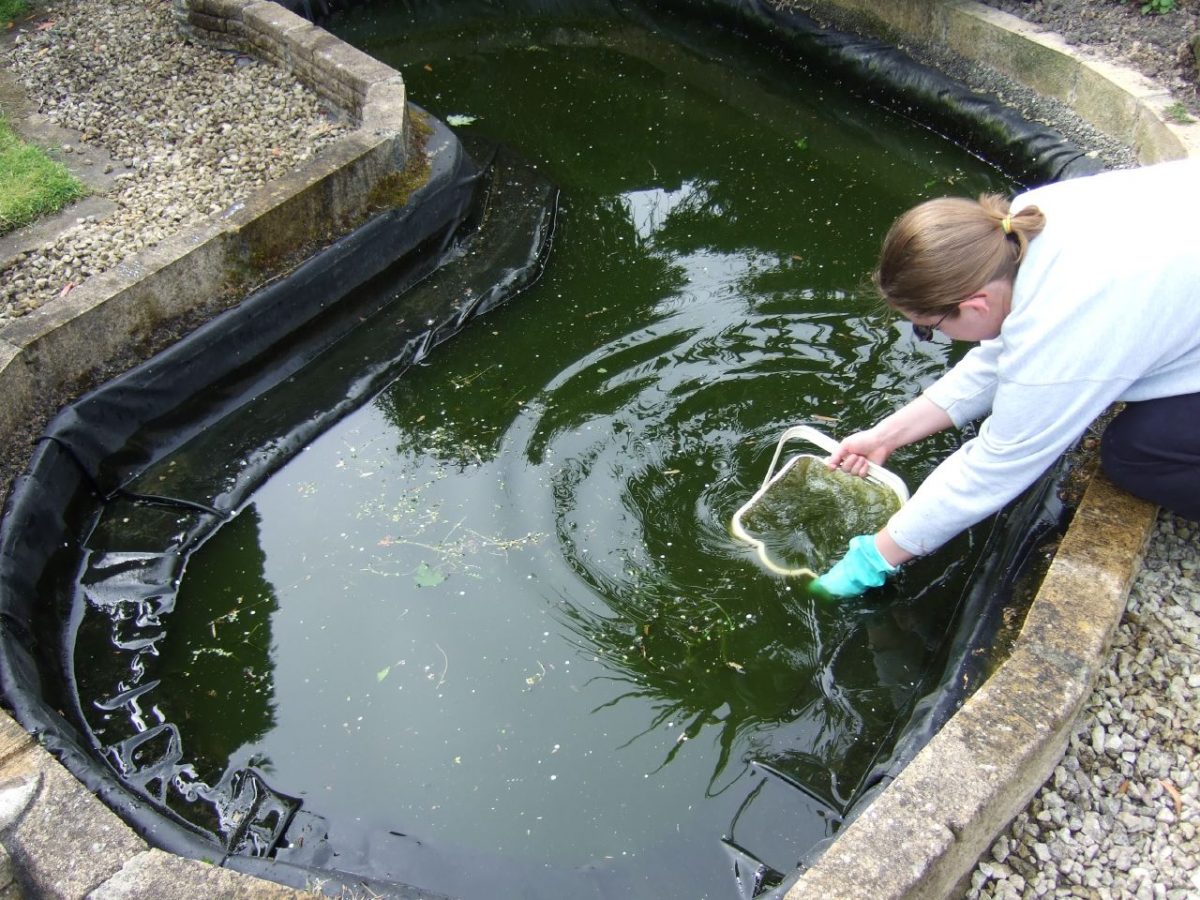
As the trees start to turn and their leaves begin to fall into the
pond, we need to remove this debris. It is a good idea to put a net
over the pond if possible. The surounding plants and the ones in the
pond will also begin to go dormant which will cause them to die away
leaving behind dead leaves and other debris. This dead organic matter,
if left in the pond will decay causing the ammonia level to rise which
is very harmful (Ammonia is discussed later). Care should be taken to
remove any floating or sunken leaves, twigs, stems, etc. as soon as
possible. Some people drain their pond and completely clean off the
sides and bottom; but, most often this is not required and in some
cases actually causes more harm than good. The fish and plants that
have been living in the pond have adapted to their environment. Any
major change may upset the balance that Mother Nature has established
and therefore could be detrimental. Netting out any dead plants, algae,
debris, etc. should be sufficient. However, it is recommended that
before the water becomes cold enough to freeze, that a 1/4 water change
be done. This willl lower the ammonia level in the pond if needed.
Remember to add a dechlorinator. Also add fresh zeolite (zeolite and
it's use is described under the heading of FISH later). This is the
time to give the filter and pump a good cleaning. However, if you are
planning to remove your pump and filter for the winter, still let it
run after the water change for a week or so. This will help to ensure
the pond has returned to a balance. If leaving the pump and filter in
the pond, it can be left running well into winter just so long as you
are careful to make sure the waterfall and stream, etc. does not freeze
and the water gets dumped from the pond as a result.
Plant life:
Hardy pond plants should be trimmed back and moved to a level in the
pond lower than where the ice is going to form. Most winters the ice is
going to be at least 8 inches thick, so the plants must be below this.
Keep in mind that your fish also need a place to spend the winter under
the ice so do not over crowd the bottom with plants to the point that
the fish may suffer. As you remove and trim back your plants, also
remove any string algae or scum that has formed around the containers.
Snails, crayfish, turtles, tadpoles, frogs, etc:
There is little you can do in the way of preparation short of removing
this type of life from the pond and keeping them indoors for the
winter, but Mother Nature has a way of watching out for her own. If
they came from a natural environment that included a cold winter, Mom
has instilled in them the means to survive. They will instinctively
seek out a place to hibernate. Some people put a shallow tube, 2 to 4
inches deep, fill with sand in the bottom of the pond in hopes the
frogs, etc. will find it and settle there for the winter. Might work,
but most ofter the fish just root around in it and muddy up the water.
During the summer months the plants that were in the pond was where
this type of life found refuge. During winter when the plants are
lowered they often will still use the containers as their home.
Fish:
Many people are under the misconception that it is the cold that causes
fish loss during the winter, but this most often is not the case. Koi
and goldfish are natural cold water fish. They are very adept at life
under the ice, that is of course, if they can breathe. Which brings us
to the number one reason fish are lost during the winter. Fish need
oxygen to breathe. They use their gills to take the oxygen from the
water. However, two by-products are also produced -- carbon monoxide
and ammonia. Both are deadly to fish. During the months when the ponds
surface is open and the plants are growing, the carbon monoxide is
dissipated into the air and absorbed the plant life in the pond.
Ammonia is removed by the filter and biological process. Oxygen is
replenished to the pond by aeration (waterfall, fountain etc.) and the
natural cycle of the plant life. During the winter as the ice forms
over the pond, the filter is not working and the plants cease to give
off oxygen, the water becomes more and more saturated with carbon
monoxide and ammonia. If the water reaches a point to where there is
not enough oxygen for the fish to breathe, death occurs. That is why it
is recommended to keep part of the surface are of the pond open to
dissipate the cabon monoxide, let oxygen in and to also include
something in the system to absorb the ammonia. How do we do that? Let
us explore the options. NOTE: make sure you read "do not do" at the end
of this test.
Do Nothing: (Usually a bad idea)
This is an option so long as you are willing to take the risk that you
pond is large enough in water volume to accommodate the number of fish
that live there. There is no rule of thumb for this, but common sense
should dictate. There is no problem keeping a few fish over the winter
in a 10,000 gallon lake that is deep enough not to freeze to the bottom
during a mild winter, but even one fish is not going to make it in a
whiskey barrel pond when the temp drops and stays at 30 below. For the
rest of this essay it is assumed that something is going to be needed
to help the fish survive.
Aeration:
This is very important. Air, oxygen needs to be added to the pond
during the winter simply because the fish are still breathing and,
therefore, using up the available supply. Also moving water takes
longer to freeze than still water. Many people use a small aquarium air
pump for this purpose and sometimes it works but sadly sometimes they
do not. The problem being is that these little pumps have little air
lines that lay on the outside of the pond before going under the water.
Condensation forms in the lines and has a habit of freezing which in
turn shuts off the air flow. They also do nothing to absorb the ammonia
(ammonia and ways to combat it is forth coming). A better way to add
aeration to the pond for winter is to use a venturi type of aerator
attached to a submerged pump. There aerators cost under twenty dollars
and are very effective in adding oxygen and water movement. How they
work is this -- the water flow from the pump is speeded up as it passes
the venturi, the venturi pulls air from a tube running up and out of
the pond. The end result is an explosion of oxygen rich bubbles.
Another benefit of this type of system is that if the water flow is
directed upwards it helps to keep a portion of the surface area of the
pond free of ice. Condensation does not effect this type of system as
much as an air pump. Click here
to see an aerator filter box you can build or purchase from us.
Deicers:
Deicers are often called "pond heaters" and this is a misconception.
They are not designed to heat the entire pond, but only to keep a hole
in the ice open enough for the carbon monoxide to escape and to let
fresh air in. The good ones have a built in thermostat that turns the
heating element on when the water temp is close to freezing. What most
of them have in common is the fact that they are actually "farm stock
tank" deicers that have been converted for pond use. A word of caution
about some deicers, even though they are not designed to heat the
entire pond they still get hot and can melt a plastic or rubber liner.
Some have a wire cage built around the exposed heating element to
prevent this. A better one has an enclosed element and is designed not
to melt plastic or rubber liners. Of course the latter is the one
recommended. One more thing about deicers -- they use a bunch of
electricity to operate. Anywhere from 1000 to 1500 watts in fact. Sure
they have a thermostat control, but often this thermostat will turn on
the deicer even when the pond is not going to freeze. It is, therefore,
recommended that the best way to use these deicers is only plug them in
when they are needed. NOTE: The ideal situation would be to have a
aerator as described above doing most of the work and also using the
deicer only when it gets extremely cold. Click
here to see the deicer that we recommend.
Ammonia:
Now we need to address the ammonia problem if we want to over winter
fish. About 80% of the ammonia in the pond comes from the fish. Most of
it from the gill function and the rest from their waste. Ammonia also
is produced from decaying organic matter, dead stuff... leaves, plants,
bugs, dead fish, etc. Left unchecked, this ammonia is going to hurt
living fish. During the warm months and with proper filtration, ammonia
is controlled by the natural biological process. When the filter is
shut down, this biological process is slowed way down and the result
can be that ammonia can build up very quickly. There is a natural
mineral called "zeolite" which absorbs ammonia. Zeolite should be used
at all times of the year, but it is very important in the fall and
during the winter months. Doing the above recommended 1/4 water change
goes a long way to reducing the ammonia level in the pond just before
the water freezes, but after it does freeze...doing a water change is
going to be difficult. Putting the right amount of zeolite into the
water flow of the system will greatly reduce the amount of ammonia. An
ideal situation would be for the zeolite to be used all winter long to
prevent ammonia build up. There are several ways to accomplish this and
if you ask us at Skippys we will show you what we use. For the purpose
of this text, just be sure to add some zeolite during the fall to the
system before the filter is shut down for the winter so any ammonia in
the water can be reduced to the best possible level before this ice
sets in. One more thing about ice, if by chance the pond freezes over
completely, DO NOT attempt to break the ice. This is like setting off
an under water bomb. The resulting concussion can be very detrimental
to the internal organs of the fish. The best way to reopen a hole in
the ice is take a pan of boiling water and gently set it on the ice.
Keep adding boiling water until the ice thaws. Click
here to find zeolite and carbon at "Stuff we Sell at
Skippys".
General tips:
Some other considerations about keeping fish alive in winter are
feeding and general health. During the winter, the fish go into a
dormant stage where their digestive system shuts down. If food is
traped in their system when this happens, it can cause them severe
health problems, even death. It is wise not to feed the fish when the
water temp is below 50 degrees. When the water temp is below 60
degrees, an easily digestible food is advised. Food that contains a
high concentration of wheat germ is good. Adding trace minerals and
vitamins to the diet is also advised at any time. But in the fall, it
is very important to ensure the fish have built up a good immune
system. Any fish that shows signs of ill health should be removed from
the pond and treated. Fish that become sick over the winter should not
be returned to the pond until spring, even after treatment.
DO NOT DO THE FOLLOWING:
CLICK HERE for
Spring Tips.
CLICK HERE for a listing of
Stuff We Sell at Skippy's.

![]() |
|
![]() |
![]() |
........... ..............COME BACK SOON |